
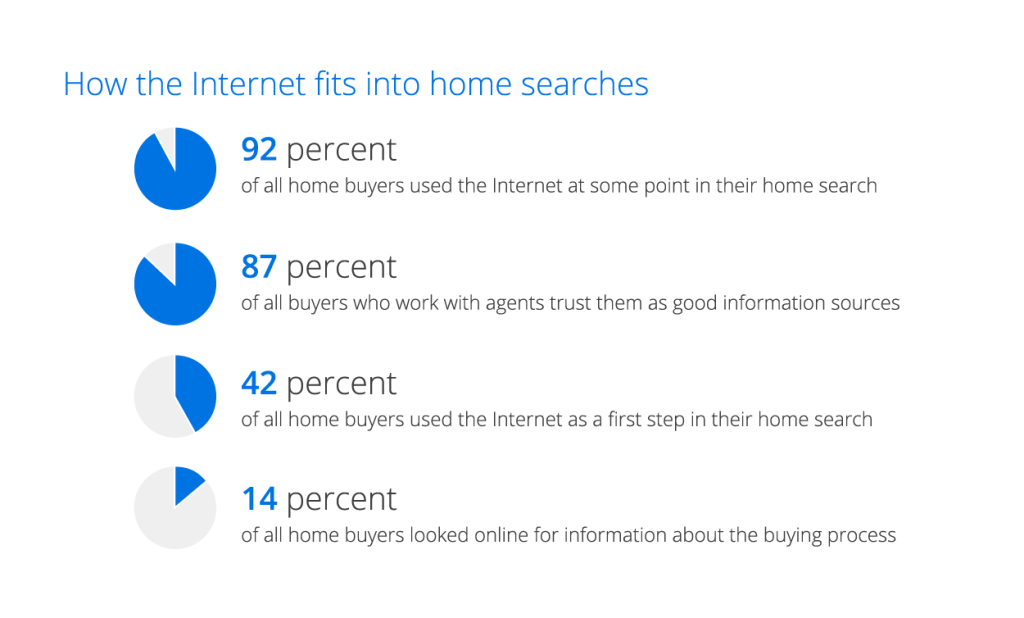
In today’s digital-first world, real estate buyers don’t start their property search with newspapers or brokers — they start with Google and social media.Over 90% of home buyers search online before contacting an agent. That means if your real estate business is not visible digitally, you are invisible to serious buyers.
Digital marketing for real estate is no longer optional — it’s a growth engine. In this blog, we’ll explore why digital marketing matters for real estate businesses, how it works, and the strategies that drive faster property sales.
What Exactly Does Real Estate Digital Marketing Strategy involve?
Online marketing of real estate also describes internet advertising strategies employed by real estate experts to market real estate, find leads, and get in contact with prospective purchasers and investors. Digital marketing covers many methods such as search engine optimization (SEO), social networking advertising, pay-per-click (PPC) ads, content advertising, and email advertising. Such marketing strategies promote visibility, interact with readers, and increase sales more effectively.
Components of Real Estate Online Marketing
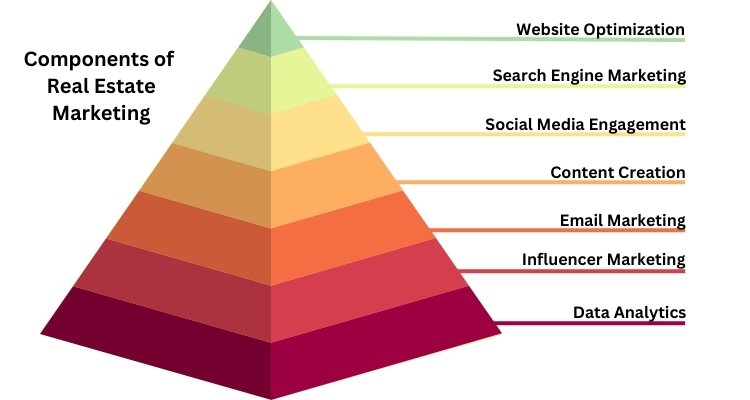
- Website Optimization – Your website is your digital showroom. It must be:
-
Mobile responsive
-
Fast loading
-
SEO optimized
-
Designed for lead capture
A poorly designed website kills conversions.
- Search Engine Marketing (SEM) – Advertising on Google guarantees immediate exposure for property listings.
When someone searches:
“Flats for sale in Pune”
“Luxury apartments in Mumbai” You must appear on top.-
SEO builds long-term organic visibility
-
Google Ads (PPC) delivers immediate traffic
The combination generates consistent leads.
-
- Social Media Engagement – Social media sites such as Instagram, Facebook, and LinkedIn enable agents to present properties visually and connect with potential clients.
Platforms like Instagram, Facebook, and LinkedIn allow you to:
-
Showcase property visuals
-
Run targeted location ads
-
Retarget interested buyers
-
Build trust through consistent branding
Real estate is visual — social media amplifies it.
-
- Content Creation – Blogs, market reports, and investment reports establish businesses as industry leaders.
Buyers want to see properties before visiting.
High-quality:
-
360° virtual tours
-
Drone footage
-
Walkthrough videos
-
Client testimonials
Increase engagement and reduce decision time.
-
- Email Marketing – Targeted emails assist in lead nurturing and converting inquiries into sales.
Most buyers don’t convert immediately.
Email campaigns help:
-
Share new listings
-
Send market updates
-
Nurture long-term leads
-
Follow up automatically
Lead nurturing increases conversion rates significantly.
-
- Influencer Marketing – Partnering with real estate influencers enhances credibility and visibility.
- Data Analytics – Monitoring visitor activity on websites assists companies in optimizing their marketing strategies.
Modern real estate marketing uses data to:
-
Track buyer behavior
-
Predict preferences
-
Retarget interested visitors
-
Optimize ad budgets
Data-driven decisions = higher ROI.
-
Why Digital Marketing Is Critical for Real Estate Businesses?
Real estate agents work in an extremely competitive environment where offline marketing strategies alone will not do. Digital marketing for real estate offers agents:
- Greater reach – Reach out to a wider audience outside local area.
With billions of internet users, digital marketing expands your reach beyond your local network.
You can attract:
-
NRIs
-
Investors
-
Relocation buyers
-
Luxury segment clients
-
- Lead generation – Draw high-intent buyers looking for homes actively.
Unlike traditional marketing, digital marketing targets users actively searching for properties.
This means:
-
Better quality leads
-
Lower cost per acquisition
-
Higher conversion rates
-
- Affordable advertising – Spend less than offline advertising yet gets more conversions.
Billboards and newspaper ads are expensive and untrackable.
Digital marketing offers:
-
Performance tracking
-
Budget control
-
Measurable ROI
-
Better targeting
You pay for results — not just visibility.
-
- Real-time communication – Interact with potential buyers in real time through social media, email, and chatbots.
Your website works even when your office is closed.
Buyers can:
-
Browse listings
-
Submit inquiries
-
Schedule visits
-
Download brochures
Automation improves response time and client satisfaction.
-
- Improved client intelligence – Apply analytics to determine client behavior and customize marketing efforts accordingly.
Consistent online presence builds:
-
Trust
-
Authority
-
Recognition
-
Local dominance
Buyers prefer brands they recognize online.
-
- Brand development – Create a powerful personal or company brand with regular online presence.
- Competitive advantage – Remain competitive by making the best use of new digital marketing technologies and trends.
How Digital Marketing Gives Real Estate Agents an Edge
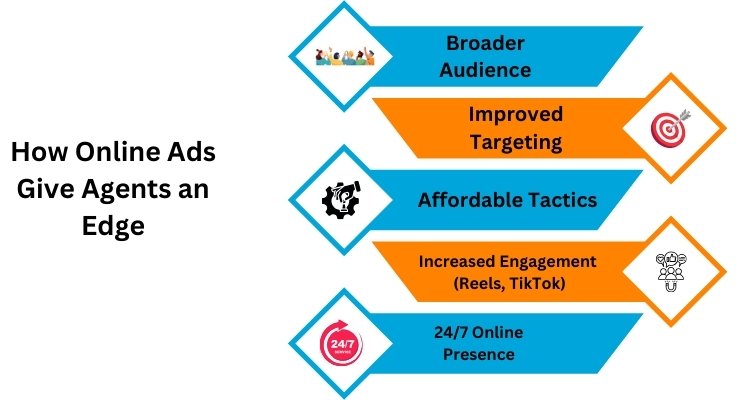
1. Broader Audience
With more than 4.9 billion internet users globally, digital marketing enables real estate companies to access a far broader audience than conventional forms of advertising such as billboards or newspaper adverts. Web platforms make it easy for you to access potential buyers and investors at various locations.
2. Improved Targeting
Internet-based advertising tools like Google Ads, Facebook Ads, and SEO make it possible for agencies to send your marketing dollars towards people actually looking to purchase or sell homes based on your geographical area of focus, such as a downtown location or even by specific high-rise buildings within an area.
3. Affordable Tactics
Digital marketing is less expensive compared to conventional marketing. For instance, social media marketing and email marketing are inexpensive but can yield high conversions and engagement. Moreover, PPC advertising only charges you when a person clicks on your advertisement, which is cost-effective.
4. Increased Engagement with Visual Content
Real estate is all about visuals, so online marketing is the best vehicle to present properties in the form of high-resolution images, virtual tours, and videos. In addition, Instagram, Facebook, and YouTube offer real estate companies an opportunity to develop informative content that brings in potential buyers.
5. 24/7 Online Presence
A well-planned real estate website with SEO-friendly content guarantees that your business is accessible at anytime and anywhere. Prospective buyers can search listings, view blog entries, and communicate with agents even during non-business hours.
The Shift from Traditional to Digital Marketing in Real Estate
In the past, real estate advertising used to be very much dependent on print media ads, billboards, and personal referrals. Today, with more than 90% of home buyers utilizing the internet in their house hunt, real estate online marketing has become imperative. The transition to digital platforms has several benefits, such as wider reach, focused advertisements, and real-time interaction with potential customers.
How beneficial is Digital marketing for real estate business?
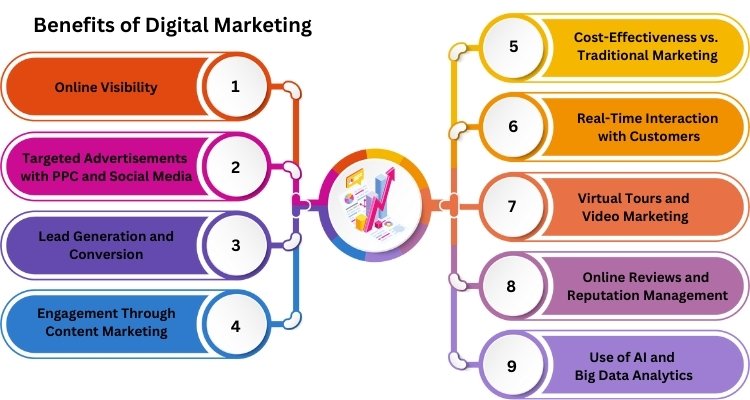
1. Increased Online Visibility
A good online presence enables real estate companies and individual agents to reach more individuals. Similarly, good Search Engine Optimization (SEO) enables real estate sites to show up at the top of search engine results, and it becomes easy for potential buyers to locate existing properties. SEO also enhances local search optimization, and businesses can target buyers who are searching for properties within their localities.
2. Targeted Advertisements with PPC and Social Media
Pay-Per-Click (PPC) advertisement and social media advertisement not only allow real estate agents to target specific geographics, demographics, and buying behaviors, but also enhance precision in audience reach. In addition, Facebook Ads, Google Ads, and Instagram promotions are some of the tools that make targeted advertisements a possibility, getting the right audience reached. PPC makes sure companies only pay for actual clicks and is thus an affordable way to market.
3. Lead Generation and Conversion
Real estate online marketing activities like email marketing, landing pages, and chatbot assistance allow for gathering of potential buyers’ information. Real estate businesses can nurture leads through personalized communications and follow-ups and thus improve conversion rates. Call-to-action (CTA) buttons and lead forms on websites also help in gathering buyer information.
4. Engagement Through Content Marketing
Content marketing is a crucial part of real estate internet marketing. For example, blogging, video walkthroughs, virtual property tours, and social media postings keep prospective buyers engaged. Moreover, quality content builds credibility and establishes real estate firms as industry leaders. In addition, market trend analysis reports, home buying guides, and investment news raise the value of potential buyers, which enhances credibility.
5. Cost-Effectiveness vs. Traditional Marketing
Real estate web-based marketing efforts generate a larger return on investment (ROI) than offline promotions. Social network and search campaign efforts that target an audience will likely be more affordable than print advertising or a billboard. The digital marketing model offers quantifiable results, and one can modify those results rather simply using the statistics.
6. Real-Time Interaction with Customers
Social media and messaging platforms provide real estate agents with the opportunity to directly interact with homebuyers. By doing so, responding to queries, providing information regarding properties, and organizing virtual tours enhance customer experience and satisfaction. Moreover, companies can offer instant responses through chatbots and AI-based tools, boosting engagement rates.
7. Virtual Tours and Video Marketing
High-definition photos and videos are major factors in determining purchasing decisions. Moreover, with the advancing technology, property companies can avail 360-degree virtual property viewing, drone shots, and video tours. Potential buyers can thereby view properties through remote browsing in their homes, leading to accelerated decision-making.
8. Online Reviews and Reputation Management
Online reviews and ratings play a strong role in deciding to buy online. Therefore, real estate businesses must work actively to sustain their online image by encouraging satisfied customers to leave good reviews on Google My Business and Trustpilot, to name a few. Positive and negative feedback responses demonstrate professionalism and credibility.
9. Use of AI and Big Data Analytics
Artificial Intelligence (AI) and big data have a great impact on real estate marketing. Specifically, AI-powered software aids in predictive analysis, identifying customer preferences, and follow-ups. Additionally, businesses can utilize AI chatbots to handle customer queries efficiently, which leads to better customer experience.
Six Strategies for Real Estate Digital Marketing
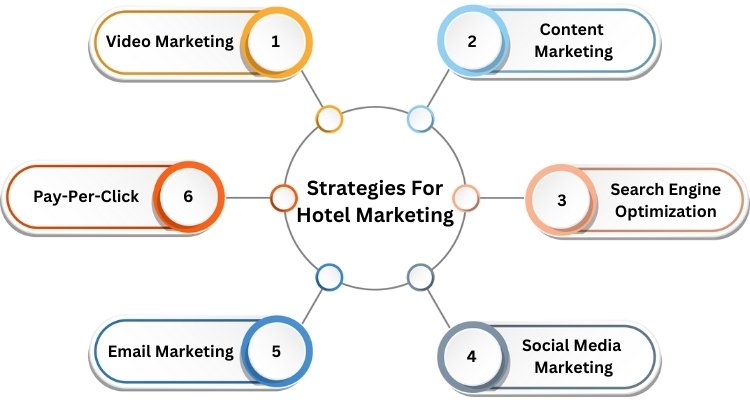
To maximize the benefits of real estate digital marketing, a real estate agency should adopt the following strategies:
1. Search Engine Optimization (SEO)
SEO helps real estate websites achieve higher rankings on top search engines such as Google. On optimized listings for properties, target keywords, along with a well-written blog, receive more organic visits and more qualified leads.
SEO helps your real estate website rank on Google for high-intent keywords like:
-
“2 BHK flats in Pune”
-
“Luxury villas in Mumbai”
-
“Commercial office space in Baner”
With proper on-page SEO, local SEO, and content marketing, you generate consistent organic traffic without paying for every click.
Best for: Long-term brand authority and sustainable lead flow.
2. Performance Marketing (High-ROI Paid Advertising Strategy)
Performance marketing is result-driven digital advertising where you pay for measurable outcomes such as:
-
Leads
-
Bookings
-
Site visits
-
Calls
-
Conversions
Unlike traditional advertising, performance marketing focuses on ROI tracking and optimization.
It includes:
-
Google Search Ads (for high-intent buyers)
-
Facebook & Instagram Lead Ads
-
YouTube Video Ads
-
Retargeting campaigns
-
Conversion tracking & analytics
Why it works for real estate:
Targets buyers actively searching
Retargets interested visitors
Tracks cost per lead (CPL)
Optimizes campaigns in real time
Scales fast when campaigns perform
Performance marketing is ideal for:
-
New project launches
-
Pre-launch campaigns
-
Inventory clearance
-
Luxury segment targeting
It generates faster results compared to organic marketing.
3. Social Media Marketing
Platforms like Instagram, Facebook, LinkedIn, and Twitter are the backbone of real estate listing promotion. Additionally, brand recognition and trust are built through quality images, virtual tours, and engagement with fans.
Social media platforms like Instagram, Facebook, and LinkedIn help real estate businesses:
-
Showcase properties visually
-
Build brand trust
-
Share market updates
-
Engage with potential buyers
Consistent posting builds credibility and increases inquiries.
4. Email Marketing
Targeted email marketing also involves contacting prospective sellers and buyers. Newsletters, market reports, and special listings of properties emailed assist in lead generation and their conversion to customers.
Most property buyers take weeks or months to decide.
Email marketing helps you:
-
Share new listings
-
Send price updates
-
Nurture cold leads
-
Automate follow-ups
Well-structured email funnels increase conversion rates significantly.
5. Reputation Management & Online Reviews
Online reputation influences buying decisions.
Encourage:
-
Google reviews
-
Client testimonials
-
Case studies
-
Social proof
Positive reviews improve credibility and local SEO rankings.
6. Video Marketing & Virtual Tours
Videos are among the best ways of marketing properties. Estate agents can produce virtual tours, walk-through videos, and testimonials from customers that boost engagement and confidence.
Real estate is highly visual.
Use:
-
360° property tours
-
Drone footage
-
Walkthrough videos
-
Client testimonials
Video content increases engagement and builds buyer confidence before site visits.
7. Content Marketing & Blogging
Developing informative real estate trend blogs, market analysis blogs, and buying guides also helps to build authority and attract potential customers through natural search.
Publishing blogs such as:
-
“Best areas to invest in Pune”
-
“Home loan guide for first-time buyers”
-
“Luxury property trends in 2026”
Helps:
✔ Build authority
✔ Improve SEO rankings
✔ Educate buyers
✔ Increase organic leads
Content builds trust before the sales call happens.
Why Choose Eternal Solutions for Real Estate Digital Marketing?
At Eternal Solutions, we specialize in performance-driven digital marketing for real estate developers, agencies, and individual agents.
With 14 years of hands-on experience working with some of the top real estate agencies and property consultants in Pune, we understand what truly drives inquiries, site visits, and bookings in the local market.
Real estate marketing is not just about running ads — it’s about understanding buyer psychology, local search behavior, and conversion funnels.
That’s where we bring a competitive edge.
Our Expertise in Real Estate Marketing
1. Local Market Intelligence – Pune Focused
We understand:
-
Buyer trends in Baner, Wakad, Kharadi, Hinjewadi, and Pimple Saudagar
-
Luxury vs. mid-segment buyer targeting
-
NRI and investor-focused campaigns
-
Launch vs. ready-to-move inventory strategies
This helps us build hyper-targeted campaigns that generate qualified leads — not just traffic.
2. Performance Marketing That Delivers Results
We create data-driven campaigns across:
-
Google Search Ads for high-intent buyers
-
Meta (Facebook & Instagram) Lead Campaigns
-
YouTube property video promotions
-
Retargeting funnels for undecided prospects
Every campaign is optimized based on:
-
Cost per lead (CPL)
-
Conversion rate
-
Quality of inquiries
-
Return on ad spend (ROAS)
Our goal is simple: More site visits. More bookings. Better ROI.
3. High-Converting Real Estate Funnels
We don’t just drive traffic — we build complete funnels:
-
Landing page optimization
-
Lead form design
-
CRM integration
-
Automated follow-up systems
-
Retargeting sequences
This ensures that no potential buyer is lost in the process.
4. Branding + Authority Building
We help real estate brands stand out through:
-
SEO-driven blogs
-
Social media strategy
-
Video marketing
-
Reputation management
-
Google My Business optimization
Because in today’s market, buyers trust visible brands.
5. Proven Experience with Top Real Estate Professionals in Pune
Our experience working with leading real estate agencies and top-performing property consultants in Pune has helped us understand:
-
What messaging converts
-
What ad creatives generate inquiries
-
How to reduce cost per lead
-
How to scale campaigns during project launches
We combine strategy, creativity, and analytics to build marketing systems that generate predictable growth.
Partner with Eternal Solutions
For Digital Marketing For Real estate In Pune | Digital Marketing For Real estate In Amravati | Digital Marketing For Real estate In Nagpur
If you’re a real estate developer, broker, or property consultant in Pune looking to:
✔ Generate high-quality buyer leads
✔ Reduce marketing cost per booking
✔ Increase project visibility
✔ Scale new launch campaigns
✔ Build long-term digital authority
Eternal Solutions can help you achieve measurable results.
Let’s turn your property inventory into booked units with the power of digital marketing.
The Future of Digital Marketing in Real Estate
As technology advances, the prospect for real estate digital marketing is bright. Additionally, AI analytics, AR property viewing, and blockchain real estate transactions are changing the way properties are sold and marketed. As a result, companies that adopt these technological advancements will have an upper hand in appealing to contemporary buyers.
FAQs for Real Estate Digital Marketing:
A real estate digital marketing company can grow your online presence, bring in more potential clients, and build your brand. They employ methods such as search engine optimization (SEO), paid advertising (e.g., Google Ads or Facebook Ads), social media management, and content production (e.g., blogs, videos, virtual tours) to reach buyers, sellers, and renters looking for properties or brokers.
Agencies typically provide:
1. SEO: Ranking your site higher on Google for search terms.
2. PPC Advertising: Paid advertising to generate traffic to your listings or site immediately.
3. Social Media Management: Managing posts, ads, and engagement on sites such as Instagram or Facebook.
4. Content Marketing: Developing blogs, videos, or virtual tours that demonstrate your expertise.
5. Email Marketing: Sending updates about properties or newsletters to cultivate leads.
6. Website Design: Creating a quick, mobile-responsive site that converts leads.
They use targeted tactics like:
1. SEO to rank for phrases such as “real estate agent near me” or “homes for sale in India.”
2. PPC advertisements to target individuals actively looking for properties or services.
3. Social media campaigns that are group-specific (e.g., first-time buyers or investors).
4. Lead magnets like free home value estimators or market reports to capture contact information.
Hiring an agency saves time and leverages expertise. They offer:
1. Expertise in tools such as SEO, analytics, and ad platforms.
2. Efficiency, leaving you free to concentrate on clients and deals.
3. Effective strategies to prevent trial-and-error expenditures.
4. Ability to scale activities as your company’s needs shift.
Costs depend on the services:
1. Small-scale plans (i.e., SEO or social media) can begin at ₹15,000 – ₹50,000/month.
2. Bundles (SEO, advertising, content) tend to cost ₹30,000 – ₹60,000/month.
3. Hourly rates can be ₹1,500 – ₹2,500/hour.
4. One-off jobs such as site builds are diverse. Ask for a quote customized to your objective for clarity.
Most do, offering:
1. Periodic posts regarding listings or market trends.
2. Targeted advertisements to find your audience.
3. Interaction with followers to establish trust.
4. Performance monitoring to better outcomes. They’ll assist in selecting platforms for your objectives (e.g., Instagram for video).
Consider:
1. Real estate experience: Look for success with similar clients.
2. Transparent reporting: Regular updates on leads, traffic, or ad results.
3. Custom plans: Strategies tailored to your market and objectives.
1. SEO: Organic growth through increases Google ranking; inexpensive long-term but slow to begin.
2. PPC: Paid advertising for immediate traffic; best for fast wins but means constant spend. A combination is usually the way forward—PPC for fast leads, SEO for long-term growth.
Yes, with:
1. Social media audience targeting (e.g., by interest or income).
2. Keyword targeting in SEO/PPC.
3. Customized content such as videos or guides for certain groups.
They emphasize:
1. Personal branding: Demonstration of your local knowledge or your value differentiation.
2. Niche concentration: Advertising to particular property types or markets.
3. Owned leads: Sending traffic to your website, not third-party sites, through SEO and advertising.
Effective options include:
1. Blogs: Market insights, buying tips, or local guides.
2. Videos: Property tours, agent intros, or testimonials.
3. Social posts: Listings, community highlights, or quick tips.
4. Emails: New listings or exclusive updates for leads
1. Use social media marketing (Facebook, Instagram, LinkedIn).
2. Optimize your website with SEO for better search rankings.
3. Run Google & Facebook Ads for targeted reach.
4. Send email newsletters with property updates.
5. Create virtual tours & 3D walkthroughs for listings.
6. Use content marketing (blogs, videos, podcasts).
7. Utilise referrals & influencer collaborations.
8. Optimize Google My Business for local searches.
1. Ignoring SEO: Max out listings with local keywords.
2. Not having a professional site: Make sure it’s mobile and speedy.
3. Utilizing low-quality graphics: Spend good photos & videos.
4. Missing client testimonials: Include reviews for authenticity.
5. Not following up on leads: Employ retargeting ads & email flows.
6. Forgetting video marketing: Utilize video tours & live Q&As.
7. Posting randomly on social: Use a consistent posting schedule.
8. Not monitoring campaign performance: Employ analytics tools to track results.
1. Watch webinars & conferences for real estate marketing.
2. Enroll in online courses from Udemy, Coursera, or HubSpot.
3. Participate in real estate marketing Facebook groups.
4. Listen to podcasts & follow YouTube channels of marketing gurus.
5. Stay connected on LinkedIn & Twitter for industry news.
6. Test new strategies and monitor results.
Online marketing raises the visibility of your property through targeted advertising, search engine optimization, social media marketing, and email marketing. This way, potential buyers are exposed to your listings immediately, resulting in faster sales.
A package of SEO, pay-per-click ads, social media advertising, video content, and email marketing is most effective. The specific approach is based on your audience and budget.


0 Comments